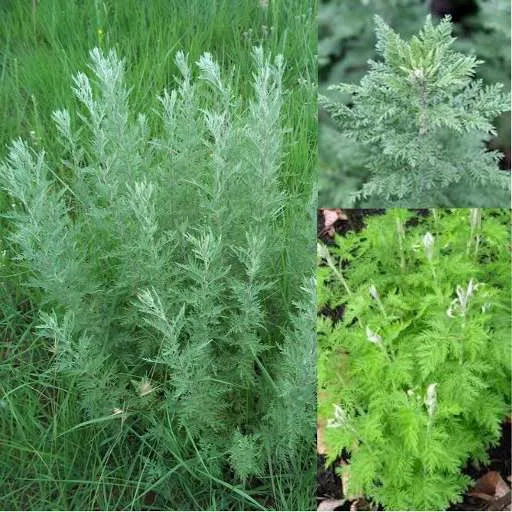
African Wormwood (Mchungu)
“Mchungu” — the bitter remedy trusted for generations across Africa. Used for malaria, coughs, colds, stomach pains, and respiratory infections. Recent research confirms its activity against tuberculosis and malaria parasites.
- 🌿Botanical Information
- 🏷Local Names
- Traditional Uses
- 🫙Preparation Methods
- 💊Dosage
- 🧪Scientific Notes
- 🍽Culinary Uses
- 🛡Safety Information
- 🌍Where it is Grown
- 🛒Where to Buy (Healers)
🌿Botanical Information
🏷Local Names
Traditional Uses
African Wormwood is one of the most widely used medicinal plants in East and Southern Africa, with a long history of traditional use dating back centuries. The plant's characteristic bitter taste and strong aromatic scent have made it a trusted remedy across many cultures [citation:5][citation:6].
Malaria and Fever
A decoction of the leaves is a widely used remedy for malaria and fever. The leaves are boiled in water and the infusion is drunk for 7 days. This treatment has been used traditionally for generations and recent research has confirmed that Artemisia afra extracts have activity against malaria parasites [citation:3][citation:7]. The plant contains only trace amounts of artemisinin but elicits a different antimalarial mechanism compared to its relative Artemisia annua, affecting lipid precursors in the parasite [citation:3].
Respiratory Health (Cough, Cold, Influenza)
The leaves are used to treat coughs, colds, chest congestion, bronchitis, and influenza. A decoction is drunk warm, or steam inhalation is used for chest conditions [citation:5][citation:6]. Traditional healers in Tanzania use the leaves for pneumonia (H037) and respiratory infections [citation:4].
Digestive Health (Stomach Pains, Colic, Intestinal Cramps)
Artemisia afra has documented spasmolytic properties—it relaxes smooth muscle contractions in the digestive tract. Laboratory studies have confirmed that the plant reduces both spontaneous and induced contractions of the duodenum and ileum, supporting its traditional use for stomach pains, colic, and intestinal cramps [citation:9]. In Tanzania, a handful of leaves is boiled to make half a liter of medicine for stomach ailments (ndwari ya ndeu) [citation:4].
Tuberculosis (TB)
Recent scientific research has discovered that an O-methylflavone compound found in Artemisia afra shows considerable activity against Mycobacterium tuberculosis, the bacterium that causes tuberculosis. This compound kills both actively growing and non-replicating (hypoxic) TB bacteria, making it particularly promising for TB treatment [citation:1]. The plant has been traditionally used to treat illnesses causing fever, and TB is an endemic cause of fever in Africa [citation:1].
Other Medicinal Uses
Traditional healers also use African Wormwood for headaches, ear infections (warm decoction instilled in the ear), nasal infections (fresh leaves inserted in nostrils to clear congestion), pneumonia, and as a parasiticide [citation:4][citation:6]. The dried leaves can be burned and the smoke inhaled for respiratory conditions.
🫙Preparation Methods
💊Dosage
🧪Scientific Notes
Antimalarial Activity
Artemisia afra contains only trace amounts of artemisinin, yet it demonstrates antimalarial activity through a different mechanism than its relative Artemisia annua. Metabolomic studies reveal that A. afra affects lipid precursors in the malaria parasite, while A. annua impacts glutathione metabolism. This research supports ongoing efforts to explore A. afra for malaria treatment [citation:3][citation:7].
Anti-Tuberculosis Activity
An O-methylflavone compound isolated from Artemisia afra has shown considerable activity against Mycobacterium tuberculosis, including against non-replicating hypoxic bacteria. This is significant because TB bacteria that are not actively growing are typically resistant to many antibiotics. The study, published in the Journal of Ethnopharmacology (2024), suggests that A. afra may have contributed to its traditional use for treating fever in TB-endemic regions [citation:1].
Spasmolytic (Anti-Cramping) Properties
Laboratory studies have confirmed that Artemisia afra significantly reduces both spontaneous and agonist-induced contractions of the duodenum and ileum. This supports the traditional use of the plant for stomach pains, colic, and intestinal cramps. The ethanol extract of the leaves showed a mean contractile response of 44.3 ± 0.9% at a dose of 160 μg/ml in isolated mouse duodenum [citation:9].
Phytochemistry
The plant contains essential oils including alpha-thujone, beta-thujone, cineole, camphor, germacrene, cadinene, alpha-terpineol, camphene, pinene, and myrcene. It also contains an O-methylflavone compound with anti-tuberculosis activity [citation:1][citation:6].
Clinical Research Status
While preclinical in vitro and in vivo studies have shown only weak biological activity (IC50 values 1000-10,000 fold less active than positive controls), two randomized controlled trials on malaria and schistosomiasis patients showed remarkably positive results. This suggests that A. afra may contain powerful "prodrugs" that require metabolism in the body to become active. Future research should focus on reproducing these clinical trials and investigating prodrug mechanisms [citation:5].
🍽Culinary Uses
No culinary uses available.
🛡Safety Information
⚠️ Important Safety Information
Artemisia afra contains thujone compounds. Excessive or prolonged ingestion may cause:
- Restlessness and vertigo
- Vomiting and tremor
- Convulsions (in severe cases)
- Fatty degeneration of the liver
Usage guidelines: Limit use to 7-14 days. Do not exceed 3g of dried herb daily. Avoid during pregnancy and lactation. Not recommended for children without proper dosage guidance [citation:6].
Drug interactions: Avoid taking with paracetamol, aspirin, iron supplements, or vitamin C during treatment [citation:2].